Case of Traumatic Brain injury with Pneumothorax treated Successfully
Successful Treatment of Traumatic Brain Injury with Pneumothorax
A 21-year-old male patient with severe traumatic brain injury following an assault was successfully treated at MAEER’s VishwaRaj Hospital. The patient sustained multiple injuries to the head, chest and abdomen, resulting in unconsciousness and requiring emergency medical intervention, neurosurgical management and intensive care.
Treating Consultant
Dr. Siraj Basade
MBBS, MS, DNB
HOD – Department of Neurosurgery
1. Case Scenario
A 21-year-old male patient with no known comorbidities was admitted following an assault with an iron rod, resulting in injuries to the head, chest and abdomen.
The patient presented with:
-
Loss of consciousness following the assault.
-
An approximately 8 × 2 × 1 cm cut lacerated wound over the right frontotemporal region.
-
A 1 × 1 × 0.5 cm wound over the left lateral eyebrow.
-
A 0.5 × 0.5 × 0.5 cm wound over the mid-forehead.
-
Multiple abrasions over the chest and abdomen.
The patient initially received treatment at a peripheral nursing home, where wound suturing was performed. Due to a low Glasgow Coma Scale (GCS) score, endotracheal intubation was required, following which the patient was shifted to VishwaRaj Hospital for advanced tertiary care management.
2. Emergency Department Management
Following admission, the Emergency Physician and Trauma Team conducted an initial assessment and rapid trauma survey.
-
Immediate resuscitation with intravenous fluids was initiated.
-
Primary stabilisation was carried out in the Emergency Department.
-
Multiple CT scans and relevant laboratory investigations were performed to assess the extent of injuries and determine the appropriate treatment approach.
3. Intensive Care Unit (ICU) Management
Upon admission to the ICU, the patient was reassessed by the on-duty Intensivist and placed on mechanical ventilator support.
Diagnostic Findings
-
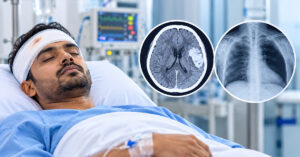
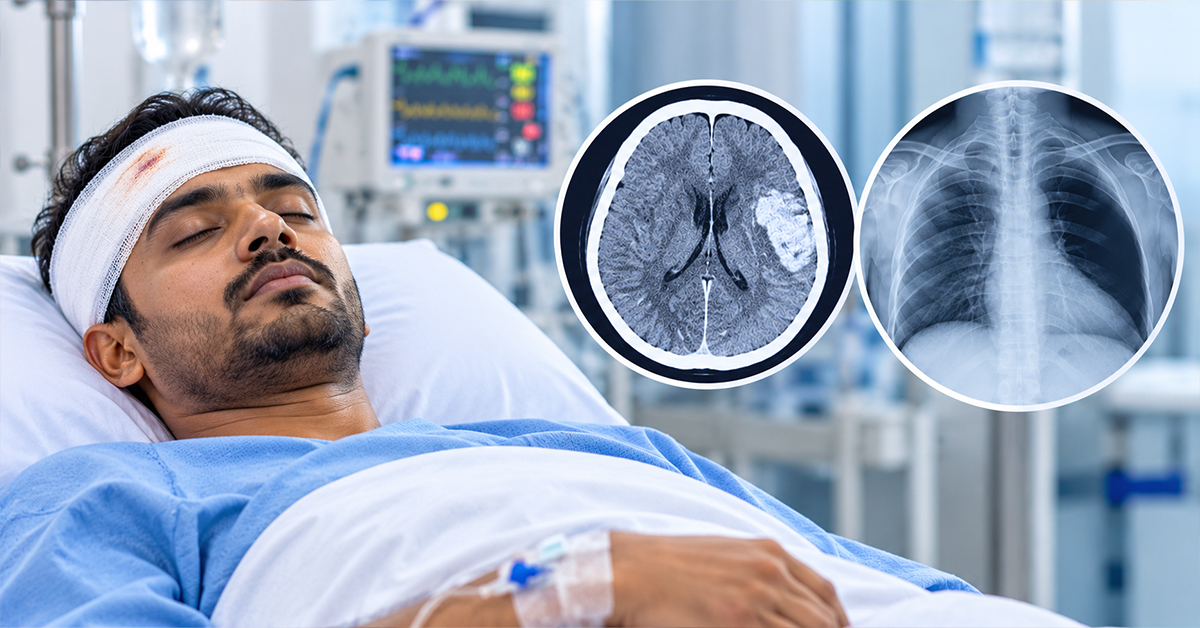
CT Brain: Significant mass effect with effacement of the lateral ventricles and a 4.8 cm midline shift towards the left. Acute subdural haematoma measuring 4 mm in the right frontoparietal region, along with haemorrhagic contusions and surrounding oedema in the right frontoparietal and bilateral frontal lobes. The largest contusion measured 4 × 3 cm.
-
Skull and Facial Injuries: Comminuted depressed fracture of the right frontoparietal bone, fractures involving the fronto-ethmoid sinus and right orbit, along with a nasal bone fracture.
-
HRCT Chest: Findings suggestive of aspiration pneumonitis.
-
CT Abdomen and Pelvis: Normal study.
Treatment and Surgical Intervention
In view of raised intracranial pressure, immediate medical management was initiated, including:
-
Antiepileptic medications.
-
Injection Mannitol.
-
3% Normal Saline (3% NS).
-
Sedation and ventilatory support.
-
Central Venous Catheter insertion.
-
Continued fluid resuscitation in the ICU.
Considering the raised intracranial pressure, the patient underwent Right FTP Craniectomy with evacuation of fracture fragments and subdural haematoma (SDH) performed by Dr. Siraj Basade, Neurosurgeon.
4. Further ICU Management and Recovery
During the ICU stay, the patient required continued critical care management and respiratory support.
The subsequent treatment and recovery included:
-
On Day 6, the patient developed hypoxia on ABG analysis. A chest X-ray revealed right-sided pneumothorax, following which an immediate right-sided Intercostal Drain (ICD) insertion was performed by the Chest Physician.
-
Ventilator weaning trials were attempted but initially unsuccessful due to patient agitation.
-
Due to difficult ventilator weaning, surgical tracheostomy was performed on Day 10.
-
Aggressive chest physiotherapy was initiated.
-
The patient’s neurological condition gradually improved. He regained consciousness, started obeying verbal commands and demonstrated movement in all four limbs.
-
Oxygenation improved, allowing removal of the right-sided ICD.
-
Neurorehabilitation and continued physiotherapy were provided.
-
The patient was successfully decannulated and shifted to the general ward on Day 20.
-
Following continued physiotherapy and recovery, the patient was successfully discharged home.
5. Medical Team Involved
Team Neurosurgery
|
Doctor |
Designation |
|---|---|
|
Dr. Siraj Basade |
Head – Department of Neurosurgery |
|
Dr. Anand Katkar |
Senior Consultant – Department of Neurosurgery |
|
Dr. Nikhil Talathi |
Senior Consultant – Department of Neurosurgery |
Team Intensive Care Unit (ICU)
|
Doctor |
Designation |
|---|---|
|
Dr. Kapil Borawake |
Director – ICU & Critical Care |
|
Dr. Vijay Khandale |
HOD – Intensive Care Unit |
|
Dr. Sanesh Garde |
Consultant ICU |
|
Dr. Satish Sarode |
Consultant ICU |
|
Dr. Sangram Ghatge |
Consultant ICU |
|
Dr. Debashish Banerjee |
Consultant ICU |
|
Dr. Sarita Bharadwaj |
Consultant ICU |
6. About MAEER’s VishwaRaj Hospital
MAEER’s VishwaRaj Hospital is committed to providing comprehensive healthcare services supported by experienced specialists, advanced medical infrastructure and dedicated critical care teams.
9,00,000+
Lives Touched
22,000+
Admitted Patients
12,000+
Surgeries
300
Bedded Hospital
400
Employees
150+
Specialist Doctors
Recommended WordPress Page Structure
For a professional hospital case study page, I recommend this order:
-
Case study banner with title and treating consultant.
-
Case overview and patient scenario.
-
Emergency department management.
-
Diagnostic findings and ICU management.
-
Surgical intervention.
-
Recovery and treatment timeline.
-
Neurosurgery and ICU medical team.
-
Hospital statistics.
-
Book an Appointment / Contact Us CTA.
More Case Study